
What happens when a man walks into the NYPD with a USB drive of 39,069 dormant Bitcoin wallets, files it as “lost property,” and gets a police receipt?
He sues New York to be declared the legal owner of about 3.8 million Bitcoin — currently worth around 286 billion dollars.
The Noah Doe Case
An individual calling himself “Noah Doe” has filed a lawsuit in New York claiming ownership of a stash of dormant Bitcoin wallets he says he discovered using an algorithm he built. According to the legal filing, Doe:
- Identified 39,069 dormant cryptocurrency wallets containing approximately 3.8 million Bitcoin
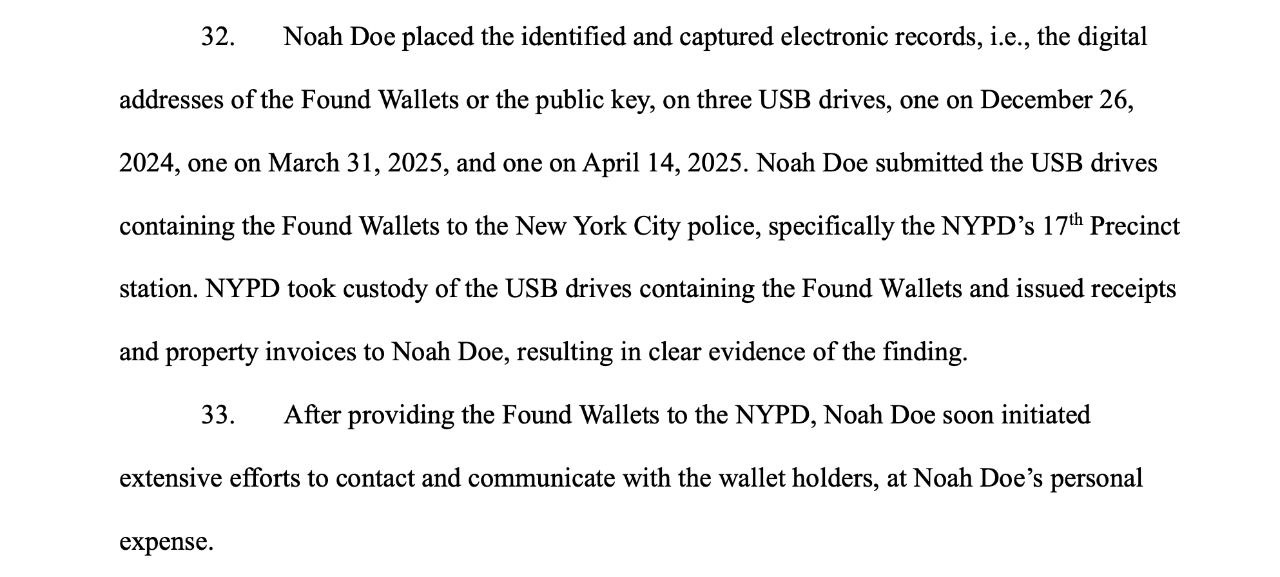
- Copied the public addresses onto three USB drives (submitted Dec 26 2024, Mar 31 2025, and Apr 14 2025)
- Walked into the NYPD’s 17th Precinct and filed the USB drives as “found property”
- Received police receipts and property invoices as evidence of his finding
- Then spent his own money trying to contact the original wallet holders
Now he is invoking a 1958 New York finders law to claim legal title to all of it.
Wallet Number One: The Mt. Gox Ghost
The very first wallet on Doe’s list is the address of the Mt. Gox hacker — 80,000 BTC stolen in 2011, untouched for 15 years, worth about 6 billion dollars today. Every on-chain analyst on Earth watches that address. It has never moved.
This single fact tells you everything about why this case is remarkable, yet also why it fundamentally misunderstands how Bitcoin works.
Ownership Is Not a Police Receipt
Here is the most important lesson in Bitcoin, and it never changes:
Whoever holds the private keys controls the Bitcoin.
Noah Doe has public addresses. He does not have private keys. A court in New York can declare him the “legal owner” of these wallets until the judges are blue in the face. It will not matter.
Without the private keys, he cannot:
- Sign a transaction
- Move a single satoshi
- Prove cryptographic ownership
- Access any of the 3.8 million BTC
Bitcoin does not care about NYPD receipts. Bitcoin does not care about 1958 finders laws. Bitcoin cares about one thing only: the private key.
The Meaning of Private Keys
Your Bitcoin private key is not a password you can reset. It is not an account you can recover with a phone call. It is the singular mathematical proof that you own your coins. The entire Bitcoin network — thousands of nodes across the planet — enforces this rule without exception.
If you have the key, you own the Bitcoin. Period.
If you do not have the key, no court, no law, no legal declaration, and no police receipt can give you control.
This is what “self-custody” actually means. It is not about paperwork. It is not about legal title. It is about cryptographic ownership — something no court can grant and no court can take away.
The Irony
Noah Doe will likely spend millions in legal fees to have a court tell him he “owns” Bitcoin he cannot spend. The real owners — if their keys are lost forever — are the only ones who could actually move it.
And if the 3.8 million BTC includes addresses whose keys were lost, burned, or forgotten, then that Bitcoin is not “found.” It is gone. No algorithm, no lawsuit, and no judge can bring it back.
The LoveIsBitcoin Take
This case is a perfect illustration of the single most important truth in Bitcoin:
Not your keys, not your coins.
Noah Doe can have a stack of police receipts three inches thick. He can have a judge sign a declaration. He can have the full force of New York law behind him.
None of it matters unless he has the private keys.
Read more: The LoveIsBitcoin Self-Custody Starter Kit
Start with buying Bitcoin through a reputable option for your region. Move it to a hardware wallet where you control the keys. Protect your seed words. Verify with your own node.
Because in Bitcoin, ownership is not a piece of paper from a courthouse. Ownership is the key.