
Quick Summary
Bitcoin’s most self-righteous fork attempt is officially dead on arrival. BIP-110 — the "save Bitcoin from the spammers" proposal that dominated protocol discourse for months — hit its mandatory enforcement phase on Saturday, split off into its own chain… and produced exactly two blocks before going completely silent.
That’s it. Two blocks. The main chain didn’t even blink. It kept mining, kept moving money, kept working — while the "purity police" who wanted to decide what you’re allowed to put on your own transaction sat frozen at block 961,633 with nobody mining for them.
If you wanted proof that no single group controls Bitcoin — not developers, not "guardians of purity," not one pseudonymous BIP author — you just got it in the most humiliating way possible.
What Happened
Quick recap for the uninitiated: BIP-110 wanted to temporarily ban storing non-financial data (images, text, "spam") inside Bitcoin transactions. Backers said it would reduce congestion. Critics said it was censorship of paid block space — if you paid the fee, you bought the right to use the block.
The proposal demanded 55% miner signaling for voluntary activation. It never got close: support peaked around 2.7%, and in the final countdown it was 2.53% — just 51 blocks out of 2,016.
Saturday, August 8, the clock ran out. At block 961,632, BIP-110 nodes began rejecting any block that didn’t signal support. That’s when the "split" happened — not because miners wanted it, but because a tiny group of node operators decided they knew better than everyone else.
What did the breakaway chain get? Two blocks, both mined by a pseudonymous group calling itself Roughnecks using Ocean’s DATUM protocol. Then nothing. Twelve hours between blocks. Then silence. By Sunday morning the main chain was already 88 blocks ahead (CoinDesk, Cointelegraph).
The mechanical reason is beautiful in its cruelty: the fork inherited Bitcoin’s full mining difficulty with roughly zero hashpower. It needs 2,016 blocks to adjust that difficulty — at its pace, that’s about 350 days. The main chain does it in 14. The fork wasn’t just unpopular; it was mathematically doomed from block one.
The Cast of Characters Nobody Asked For
The whole saga had everything. Luke Dashjr refusing to withdraw a proposal with under 3% support while Mempool laughed at him — "lol, you are the one forking off". A pseudonymous author, Dathon Ohm. And a "prominent Bitcoin Core contributor" who reportedly urged everyone to stop transacting during the second week of August. Stop using Bitcoin. To prove that Bitcoin needed fixing.
Saylor called it a "Bitcoin Iatrogenic Proposal" — a treatment that harms the patient — and published 110 reasons against it. Adam Back’s test was simpler: if the change wouldn’t work for TCP/IP, it doesn’t belong in Bitcoin. He destroyed the argument in one question. Foundry, AntPool, F2Pool, ViaBTC — none of the big pools ever signaled support.
And when the fork finally happened, the network’s answer was a collective shrug. AntPool mined the first non-signaling block. The main chain accepted it. Everyone kept moving. (For the full history of how we got here, here’s the OP_RETURN battle from 40 bytes to 100,000.)
Why It Matters
This was never about block space. This was a test of whether a minority — armed with software, conviction, and zero economic weight — could force Bitcoin to change against the will of its users and miners. The answer: no. Emphatically no.
Bitcoin’s governance isn’t a vote count on GitHub. It’s economics. It’s 100,000+ blocks of history, thousands of nodes, and the collective decision of the people who actually run the network. A rule change nobody wants isn’t a rule change — it’s a LARP.
One serious warning in here: if anyone tries to sell you "fork coins" from the BIP-110 chain, walk away. Both chains accept identical transactions — a replay attack could let a buyer rebroadcast your transaction on the main chain and collect real BTC. The fork coin isn’t a free airdrop; it’s a trap with extra steps.
And the deeper question nobody wants to answer: if a "Bitcoin improvement" can’t win even 3% of miners, was it ever an improvement? Or was it an attempted takeover by people who think they own the protocol?
FAQ
Q: Is my Bitcoin safe?
A: Yes. The main chain never stopped. Your coins are on the chain everyone actually uses.
Q: Did BIP-110 activate?
A: No. Voluntary activation needed 55% signaling. It got 2.53%. The enforcing branch is frozen at block 961,633 with no miners behind it.
Q: Should I buy the "new" BIP-110 coin?
A: No. It’s a replay-risk minefield and the chain can’t even produce a third block. You’d be buying a ghost.
Q: Is this the end of the BIP-110 story?
A: The mandatory signaling window technically runs through block 963,647, but with the branch stalled and support under 3%, this thing is dead in the water. Hodler’s Digest called it "a whimper." That’s generous.
Final Thoughts
Two blocks. That’s the entire legacy of the most hyped governance battle since SegWit. The "purity police" spent months calling everyone else a spammer, then needed a pseudonymous mining group to produce two lonely blocks before the network forgot they existed.
Bitcoin doesn’t need guardians of purity. It needs users, miners, and nodes who actually agree on the rules — and this weekend, the rules won.
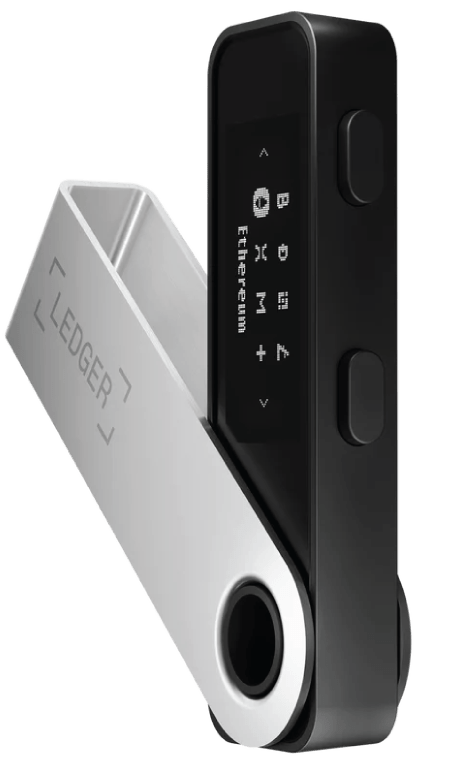
Before you go: if you’re stacking sats and you want them somewhere the "purity police" can’t reach them, get a proper hardware wallet. Bull Bitcoin has you covered — and code LOVEISBITCOIN gets you the deal. Self-custody isn’t a feature. It’s the whole point.
So here’s the question, and I want you in the comments: If a "Bitcoin improvement" couldn’t win 3% of the network’s support, was it ever an improvement — or was it always just an attempted takeover by people who think they know how to use your money better than you do?