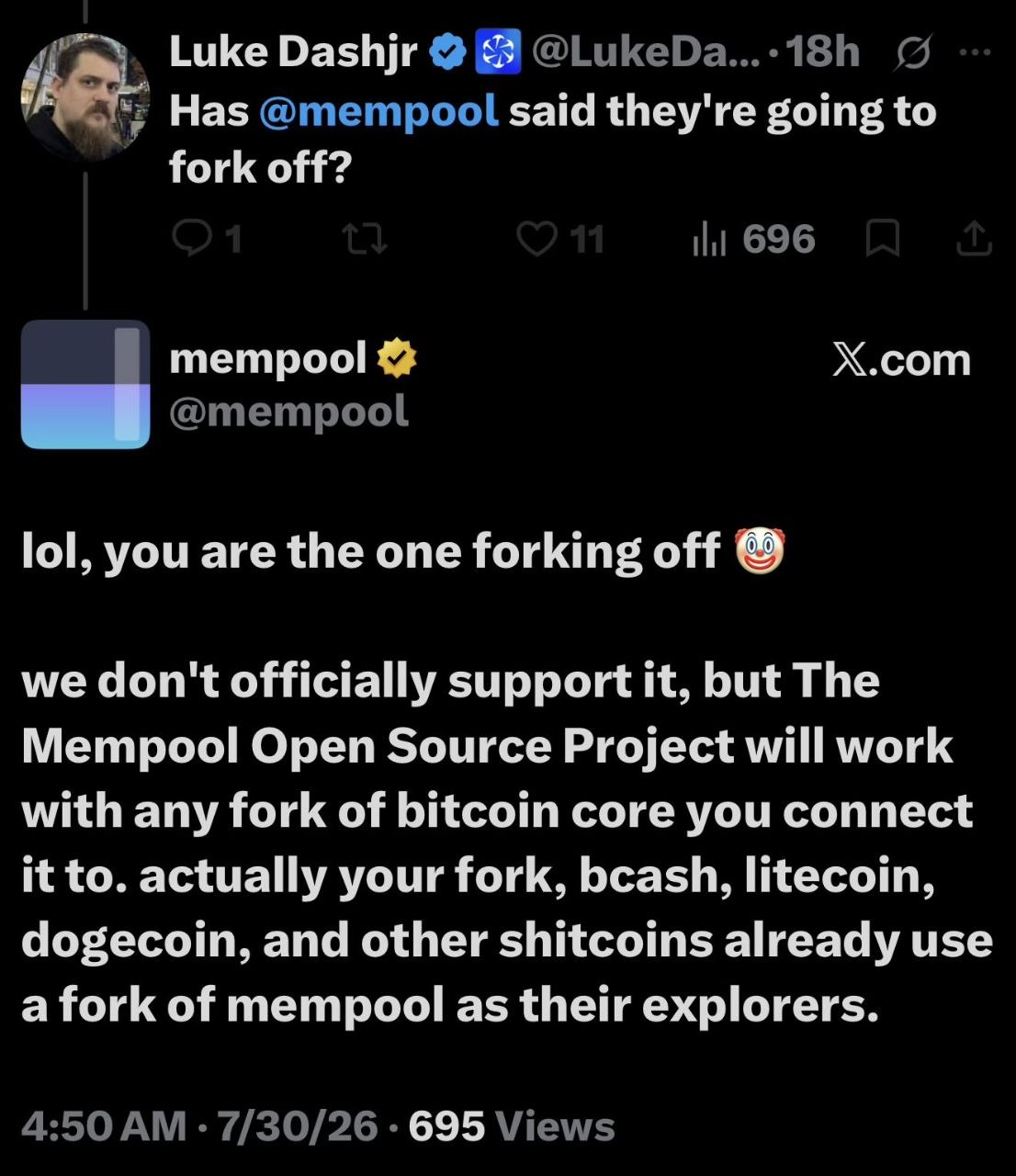

“lol, you are the one forking off 🤡”
That’s the entire energy of the exchange that dropped on July 30, 2026.
Luke Dashjr asked a simple question:
Has @mempool said they’re going to fork off?
Mempool replied almost immediately:
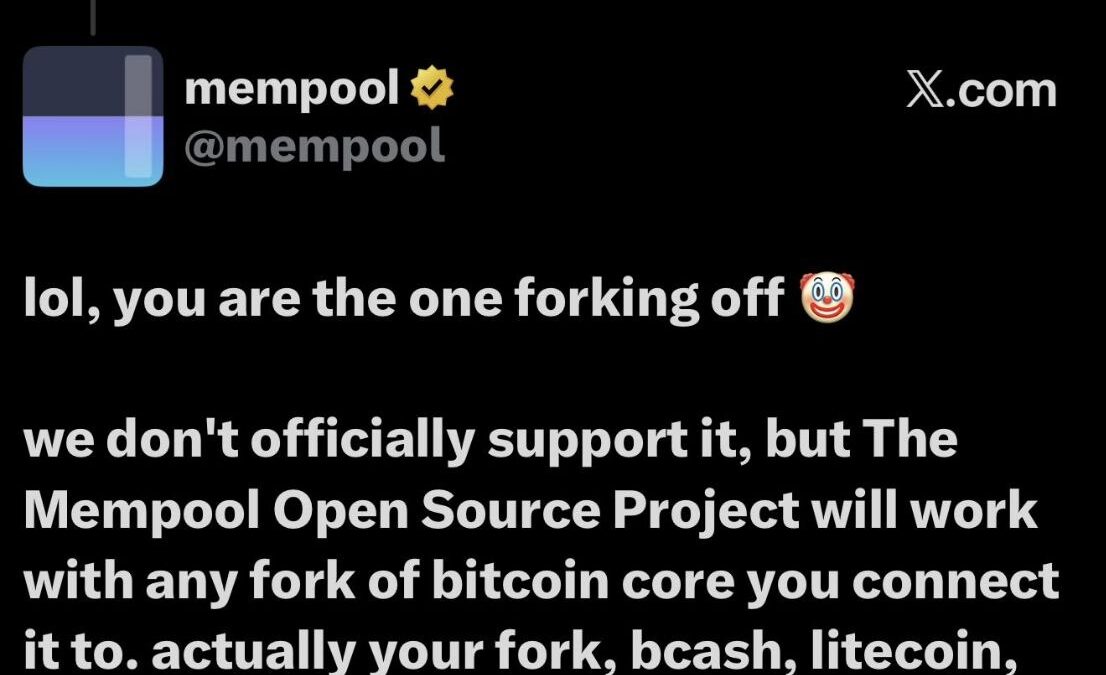
lol, you are the one forking off 🤡
we don’t officially support it, but The Mempool Open Source Project will work with any fork of bitcoin core you connect it to. actually your fork, bcash, litecoin, dogecoin, and other shitcoins already use a fork of mempool as their explorers.
Luke’s one-word response: “Nope 🤡”
What’s Actually Going On
This isn’t random shitposting. It’s a surface-level flare-up of the BIP-110 / RDTS (Reduced Data Temporary Softfork) civil war.
BIP-110 is the temporary soft fork (roughly one year) that would heavily restrict arbitrary data embedding on Bitcoin — the main techniques used by Ordinals, inscriptions, BRC-20s, and similar schemes. It restores tighter limits on OP_RETURN, data pushes, certain Taproot constructions, and related vectors while grandfathering existing UTXOs. The stated goal is to stop treating Bitcoin as a general-purpose data storage layer and refocus it on money.
It ships in Bitcoin Knots (Luke’s long-running Core fork). Activation uses a modified BIP9 scheme with a relatively low 55% miner threshold for early lock-in and a mandatory signaling / UASF-style fallback in early August if that fails. Miner signaling has been near zero for most of the process. Node support is higher, concentrated in Knots.
Luke’s camp frames Core’s earlier policy changes (especially around OP_RETURN) as the real deviation from Bitcoin’s historical norms, and BIP-110 as the corrective restoration. Critics see it as a contested consensus change with aggressive activation parameters that risks a persistent chain split, and they reject the idea that data limits belong in consensus rules rather than policy.
Mempool’s Actual Position
Their reply is technically accurate and deliberately pointed.
The Mempool Open Source Project is designed to talk to whatever Bitcoin Core-compatible node you point it at. It does not enforce its own consensus rules. Connect it to a Knots node enforcing BIP-110 and it will reflect that view of the chain. Connect it to a non-enforcing Core node and it will show the other view. The same codebase already powers explorers for Bitcoin Cash, Litecoin, Dogecoin, and various other chains because people forked it and pointed it at different networks.
Calling Luke’s project “your fork” and grouping it with the alts is the rhetorical knife. From Mempool’s perspective, the open-source project stays neutral; the people choosing which consensus rules to run are the ones creating divergence.
Luke’s “Nope” is consistent with his long-standing view: BIP-110 is Bitcoin, the other side is the one departing from the protocol’s purpose, and therefore the people who refuse to enforce it are the ones forking off.
Why This Exchange Matters
Most Bitcoin drama stays in developer channels or maxi vs shitcoiner shouting matches. This one is about infrastructure neutrality under contested soft-fork pressure.
Public explorers, wallet backends, and “be your own bank” apps that still lean on remote services create a quiet centralization of perception. Even if you run a full node, a lot of the tools people actually use every day still query someone else’s view of the mempool and chain tip. When the ruleset itself is contested, that dependency becomes visible.
Who’s forking off? Depends who you ask. And that’s exactly the problem.