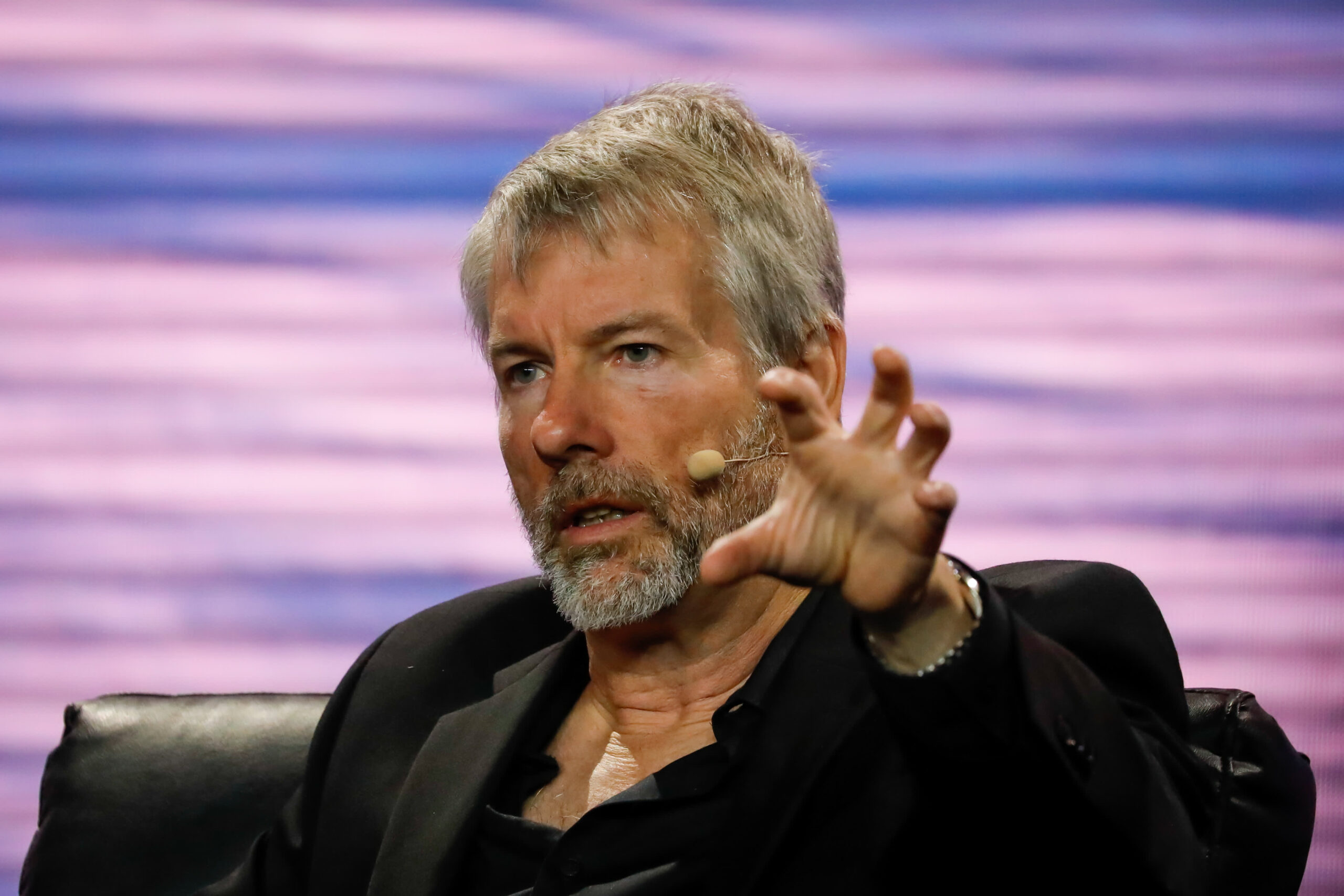
SAYLOR ADMITTED IT: 98% BITCOIN BUCKLES – WALL STREET WANTS 3 YEARS OF CASH, NOT 30 YEARS OF BITCOIN

Quick Summary
- Michael Saylor admitted at ParaFi Investor Day that Bitcoin backing alone could not keep Strategy’s 12%-yield preferred stock, Stretch (STRC), at its $100 par value.
- STRC slipped below par over the summer and traded near $75. Strategy’s answer was a US dollar dividend reserve and roughly $1.5 billion of buybacks that pushed it back to within cents of par.
- His new rule, in his own words: if you created it as 98% Bitcoin and 2% cash, it tends to buckle. If you make it 70% Bitcoin and 30% cash, think of stainless steel.
- Credit buyers, he said, would rather see three years of dollars than thirty years of Bitcoin. Strategy now holds about three and a half years of dividends in cash.
- The cash cushion has a cost: in recent weeks Strategy spent more on its own shares than on new Bitcoin.
What Happened
Michael Saylor spent years telling the world that Bitcoin is the best collateral on earth. This week, at ParaFi Investor Day, he told a room full of credit investors something very different: Bitcoin by itself was not enough.
His preferred stock is called Stretch, ticker STRC. It pays a 12% annual dividend and is designed to sit at $100 a share. Early in the summer it fell below that line, and it later slid to roughly $75. That is a 25% haircut on an instrument that was sold to income investors as stability.
Strategy’s fix was not more Bitcoin. It was dollars. The company stood up a US dollar dividend reserve, repurchased about $1.5 billion of STRC, and got the price back to within a few cents of par.
Saylor’s summary of the lesson is the part that belongs in every treasury company prospectus: credit buyers would rather see three years of dollars than thirty years of Bitcoin. Then he handed the room a formula. Ninety-eight percent Bitcoin and two percent cash buckles. Seventy percent Bitcoin and thirty percent cash is stainless steel.
Strategy now holds about three and a half years of dividends in cash, and it wants to pay STRC dividends daily if shareholders approve. Saylor expects STRC to eventually trade 400 to 500 basis points above the risk-free rate, still a yield that has to be earned every single month.
Gold advocate Peter Schiff says the company has lost its Bitcoin-buying power. Saylor’s answer: credit investors want a three-year track record, and digital credit is only in its second year.
Why This Matters for Bitcoin
Read that quote again. The loudest Bitcoin evangelist on the planet just told professional lenders that 98% Bitcoin is structurally unsound, and that the fix is a stack of fiat three years deep.
For a company, that is rational. A public company has a dividend calendar, a credit rating, and shareholders who want income. Cash is the only thing that pays a coupon on the day it is due. Bitcoin pays nothing until you sell it, and the moment a treasury company sells, the market punishes the narrative that got it there.
That is the trap of the corporate treasury model. It works beautifully in an uptrend, when the stock trades at a premium and the company can issue more paper. It gets ugly when the premium closes and the paper that was sold needs actual money. Saylor is not confessing weakness here. He is describing the machine honestly for the first time, and the machine needs dollars to keep Bitcoin on its balance sheet.
It is the same company that published a 93% crash warning inside its own Bitcoin buyer guide this year, while telling retail holders to never sell. One set of rules for the balance sheet. Another set for you.
Which raises the question every holder should be asking: if the largest corporate Bitcoin treasury in the world needs a three-year cash buffer to keep its promises, what exactly is the Bitcoin you hold through a custodian doing for you?
Nothing. It is sitting there. The difference is that your Bitcoin has no dividend to pay, no par value to defend, and no counterparty who needs dollars to keep the arrangement alive. That is not a bug. That is the entire point.
The Love Is Bitcoin Takeaway
There are two ways to own Bitcoin and they are not the same thing.
One is a balance sheet. It comes with obligations: dividends, interest, index rules, credit ratings, a stock price that punishes patience. That Bitcoin is leveraged, pledged, and always one bad quarter away from being sold to defend something else. The never sell preachers have spent 2026 showing you what they defend first, and it was never your stack.
The other is self-custody. It pays no dividend because it owes nobody anything. No par value, no credit committee, no cash cushion required, because there is no promise to break. Your Bitcoin does not buckle at 98% concentration. It is not stainless steel either. It is simply yours.
Saylor needs dollars because he made promises to strangers. You did not. That asymmetry is the whole game, and it is the reason his advice and your strategy were never the same advice.
Want to stack on the other side of that line? Every sat you buy through us carries the coupon code LOVEISBITCOIN at https://loveisbitcoin.com/bull – no custodian, no yield promises, no par value to defend.
What Beginners Should Do Next
- Learn how Bitcoin wallets work before you buy anything.
- Understand the difference between holding Bitcoin and holding a claim on Bitcoin. ETFs are not the same as holding keys.
- Understand that treasury companies are businesses with obligations, not savings accounts with a ticker.
- Ask who can be forced to sell. If the answer includes the entity holding your coins, you do not own Bitcoin. You own exposure to somebody else promises.
FAQ
Did Saylor say Bitcoin is bad collateral?
He said Bitcoin backing alone could not hold STRC at its $100 target, and that credit buyers wanted a cash cushion before they returned.
What is STRC?
Stretch, Strategy’s perpetual preferred stock. It pays a 12% annual dividend and targets a $100 share price.
How much did Strategy spend defending it?
About $1.5 billion of buybacks, which brought STRC back to within a few cents of par.
Does this mean Strategy is selling Bitcoin?
Strategy has spent more on buybacks than on new Bitcoin in recent weeks, and it sold Bitcoin earlier in 2026 to fund preferred dividends and repurchases.
Should I buy a Bitcoin treasury stock instead of Bitcoin?
A treasury stock is a leveraged bet on a company’s ability to keep promises. Bitcoin is the asset underneath. They are not interchangeable.
What is self-custody?
Holding the keys to your own Bitcoin, so that no company, court, or creditor stands between you and your coins.
Is this financial advice?
No. This is education.
Final Thoughts
Nothing Saylor said this week is an argument against Bitcoin. It is an argument against leverage, against promises, and against the idea that somebody else balance sheet is a substitute for your own keys.
The people who sold you never sell now hold three and a half years of dollars to keep their own promises. That is not hypocrisy. It is arithmetic. Their structure needs cash because their structure makes promises.
Yours does not. That is why you can sleep through a drawdown they have to manage.
So here is the question worth arguing about in the comments: if the biggest Bitcoin treasury on earth needs three years of fiat to stay standing, why would you ever let a custodian hold yours?
This article is for education only and is not financial advice.
SAYLOR ADMITTED IT: 98% BITCOIN BUCKLES - WALL STREET WANTS 3 YEARS OF CASH, NOT 30 YEARS OF BITCOIN